Running - category overview | NorthPeak
Category entry point inside the analysed scope.
https://northpeak.example/se/running
EVIDENCE-FIRST COMPETITOR ANALYSIS
Compare the exact pages that matter, using the same criteria for every competitor. Turn observed signals into clear, defensible next steps.
Illustrative comparison using fictional companies.
Product proof
Start with the comparison. Open the supporting page. See what was observed and what remains uncertain.
Illustrative comparison using fictional companies and findings.
Category entry point inside the analysed scope.
https://northpeak.example/se/running
Listing page with price and availability per product.
https://northpeak.example/se/running/road
Who it's for
How it works
Define the precise part of each site you want to compare.
NorthPeak
northpeak.example/se/running
Path and child pages
Trailora
trailora.example/se/running
Path and child pages
See your baseline and competitors assessed against the same criteria.
| Area | NorthPeak | Trailora |
|---|---|---|
| Indexability & crawl | Moderate | Strong |
| On-page structure | Strong | Strong |
| Structured data | Strong | Strong |
Trace each conclusion back to the material it was based on.
Evidence · NorthPeak
Category entry point inside the analysed scope.
https://northpeak.example/se/running
Listing page with price and availability per product.
https://northpeak.example/se/running/road
OUTDOOR & RUNNING CATEGORY · SYNTHETIC EXAMPLE
NorthPeak
northpeak.example/se/running
Path and child pages
Trailora
trailora.example/se/running
Path and child pages
The assessment
The same method for your own site and every competitor, within the scope you select.
Audience and ICP signals inferred from the analysed pages. Always labelled as inferred - a public site never proves an internal ICP.
How clearly the offer, the audience and the differentiation are stated inside the scope, and how consistently they are repeated.
Indexability, on-page structure, metadata and structured data inside the exact scope you selected.
A readiness assessment based on what is on the page. CompComp does not query ChatGPT, Gemini or Perplexity and never claims a ranking or a citation.
Generative Engine Optimization (GEO) assesses how clearly AI-powered search and answer systems can understand, verify and attribute the information on your site. CompComp checks structure, factual clarity, attribution, answerable content and crawler accessibility.
Product identity, variants, attributes, price and offers, availability, merchant details, delivery, returns, reviews and purchase-path clarity. Separately, CompComp checks the standard Universal Commerce Protocol (UCP) discovery profile for its declared version, services, transports, capabilities and payment handlers. Product schema and identifiers remain normal ACO evidence - never proof of UCP support.
Strengths, weaknesses, opportunities and threats drawn from the evidence already collected, not written freehand.
The difference
How well does one site perform against a checklist? Useful for a backlog, but not a view of the competition.
How does this exact scope compare with these competitors, on the same criteria, with evidence attached?
Category overview
CompComp connects the dots across disciplines and turns evidence into clear, actionable findings. Levels below are our own reading of each category's primary focus, not vendor benchmarks.
| Solution | SEO | AI/GEO | Competitor positioning | UX/site assessment | SWOT/ICP | Evidence | Recommended actions |
|---|---|---|---|---|---|---|---|
CompCompCompetitive digital assessment | Strong | Strong | Strong | Strong | Strong | Core principle | Core output |
SemrushSearch/marketing intelligence | Excellent | Strong | Medium | Low | Low | Strong | Strong |
ProfoundAI search visibility | Low | Excellent | Medium | Low | Low | Strong | Strong |
Peec AIAI visibility tracking | Low | Excellent | Medium | Low | Low | Strong | Medium |
SimilarwebTraffic/market intelligence | Medium | Growing | Medium | Low | Low | Excellent | Medium |
CrayonCompetitive intelligence | Low | Low | Excellent | Low | Medium | Excellent | Medium |
Inside the product
See how CompComp moves from defining competitors to side-by-side comparison and detailed evidence-backed analysis.
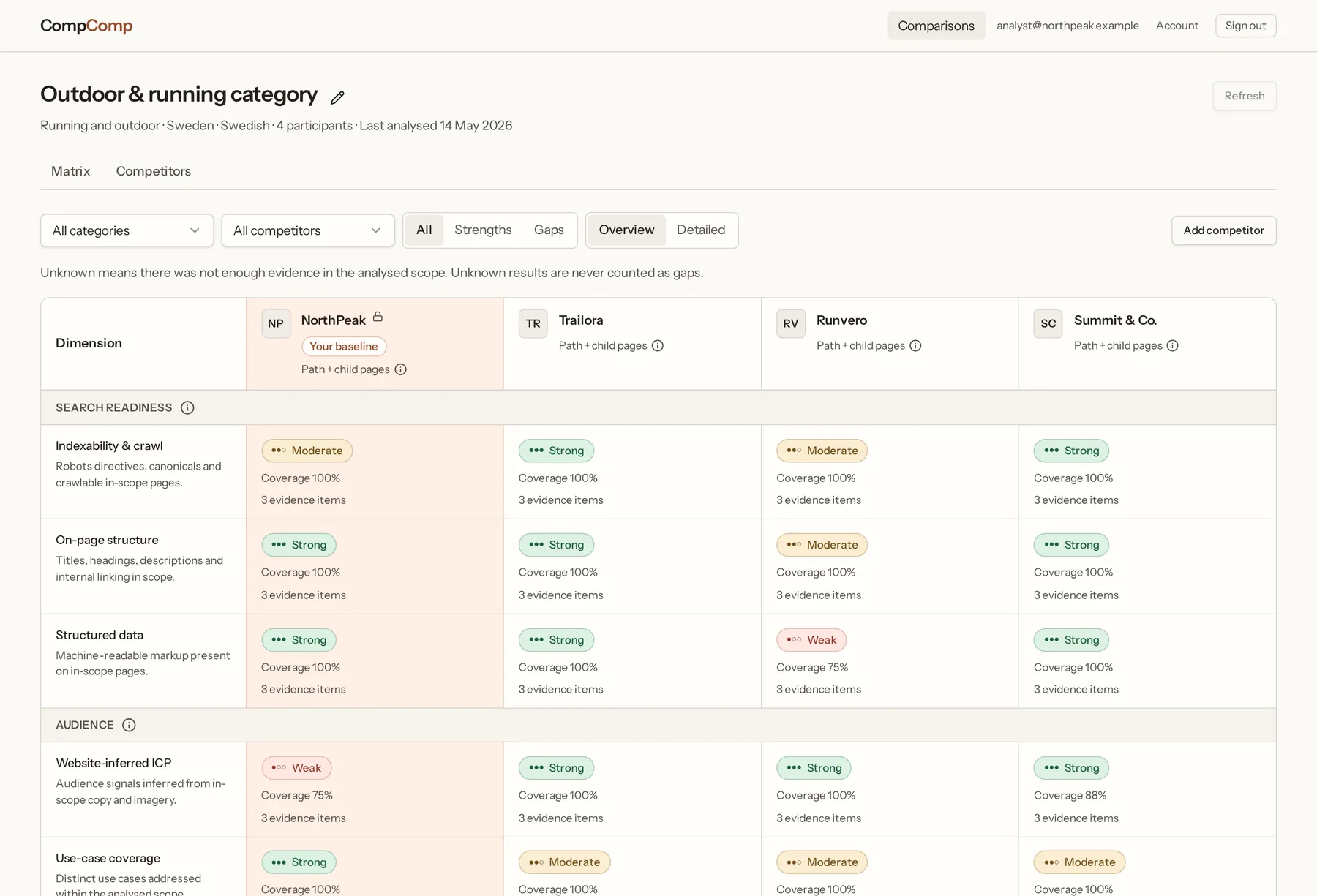
Companies as columns, analysis areas as rows. Your baseline stays highlighted, coverage is shown next to each assessment, and Unknown is reported as missing evidence rather than a gap.
Screenshots show the CompComp interface using a demonstration comparison. Company names, domains and findings are fictional.
Want to see this applied to a real scenario? Read the brand channel comparison use case.
Applications
Sister product
CompComp compares ecommerce experiences: a site, a subdomain, a category or PLP, a product or PDP, or another selected path, against the competitors your customers actually see.
CommerceSpy compares commerce technology solutions and vendors: their positioning, capabilities, AI commerce readiness and evidence of how those capabilities are brought to market.
Where CompComp asks how your digital experience compares with competitors, CommerceSpy asks how a commerce technology solution compares with the other solutions available to ecommerce teams.
Two tools, two different competitive questions.
How does our ecommerce experience compare with the competitors our customers see?
How does this commerce technology solution or vendor compare with other solutions in its market?
